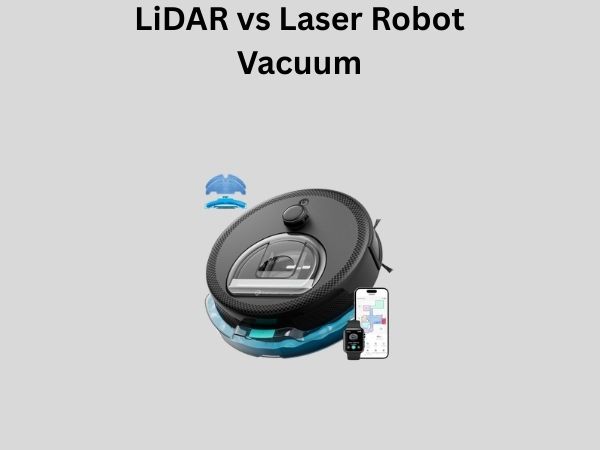
LiDAR vs Laser Robot Vacuum: Understanding the Best Tech for Your Floors
So you’re thinking about getting a robot vacuum, right? You’ve probably seen those sleek little machines zipping around people’s homes on social media, and you’re wondering what all the fuss is about. But here’s the thing—not all robot vacuums are created equal. When you start digging into the specs, you’ll encounter two technologies that seem to do basically the same thing: LiDAR and laser. Let me tell you, understanding the difference between these two could save you hundreds of dollars and help you pick the perfect cleaning companion for your home.
The Foundation: How Robot Vacuums Actually Navigate
Here’s something fascinating—just a few years ago, robot vacuums were basically bumbling around your house like they were wearing a blindfold. They’d bump into things, get stuck, and somehow manage to spend fifteen minutes cleaning the same two square feet of your kitchen. But technology has evolved dramatically.
Today’s intelligent robot vacuums use sophisticated navigation systems to understand your home layout, plan efficient routes, and avoid obstacles like they’re performing an intricate dance. Two main technologies dominate this space: LiDAR and laser navigation. But before we dive into their differences, let’s understand what they’re actually doing.
The Basic Principle Behind Navigation Tech
Both LiDAR and laser systems work on a fundamental principle: sending out light or signals and measuring how long it takes for those signals to bounce back. It’s kind of like how a bat uses echolocation, except instead of sound waves, we’re talking about light. The vacuum essentially takes thousands of these measurements to create a detailed map of your home, allowing it to move intelligently and avoid collisions.
What Is LiDAR Technology?
LiDAR stands for Light Detection and Ranging, and honestly, it’s become the darling of the robot vacuum world. When manufacturers talk about premium navigation, they’re usually referring to LiDAR.
How LiDAR Works in Robot Vacuums
LiDAR uses a rotating laser on top of the vacuum to emit thousands of light pulses in all directions simultaneously. Think of it like the vacuum is constantly scanning a complete 360-degree sphere around itself. These pulses bounce off walls, furniture, and other objects, and the vacuum’s sensors measure the time it takes for each pulse to return.
This creates an incredibly detailed point cloud—basically a three-dimensional map of everything in the vacuum’s immediate vicinity. The system updates this information multiple times per second, which means the vacuum has an almost real-time understanding of its environment.
LiDAR’s Strengths and Advantages
- Creates detailed, accurate floor maps
- Excellent performance in low-light conditions
- Fast mapping of new areas
- Precise obstacle avoidance
- Better understanding of room dimensions
- Consistent performance regardless of floor color or reflectivity
- More efficient cleaning patterns
What really makes LiDAR shine is its independence from environmental factors. Whether your living room has dark hardwood floors or light carpeting, whether it’s bright midday or dimly lit evening, LiDAR performs consistently. It doesn’t get confused by mirrors or reflective surfaces the way some other technologies might.
Understanding Laser Navigation Systems
Now, you might be thinking that “laser” and “LiDAR” are basically the same thing—and I understand the confusion. But there’s actually a meaningful difference in how they operate.
How Laser Navigation Works
Laser navigation, sometimes called “laser distance sensor” or “adaptive infrared,” typically uses a single laser or a small number of laser sensors pointing in specific directions—usually forward and sometimes to the sides. Instead of scanning a complete 360 degrees like LiDAR, laser systems measure distances in more limited directions.
The vacuum uses these measurements to understand if there’s an obstacle directly ahead or to the side, and it uses this information along with other sensors (like bumpers and cliff sensors) to navigate. Some laser systems also track walls as reference points to help maintain straight lines while cleaning.
The Advantages of Laser Navigation
- More affordable than LiDAR systems
- Lower power consumption
- Simpler mechanical design
- Adequate for basic obstacle avoidance
- Generally reliable for straightforward home layouts
- Good performance in low-light conditions
Here’s where laser navigation really shines: price. Vacuums with laser navigation are typically significantly cheaper than their LiDAR-equipped counterparts. If you’ve got a relatively simple home layout and don’t need the most advanced mapping features, laser navigation can absolutely get the job done.
Key Differences: LiDAR Versus Laser Explained
Let me break down the most important differences so you can make an informed decision for your specific situation.
Coverage and Scanning Range
LiDAR scans a complete 360-degree circle around the vacuum, creating comprehensive awareness of the entire environment. Laser navigation, on the other hand, typically focuses on forward-facing or limited directional scanning. This means LiDAR gets a much fuller picture of your home layout.
Mapping Accuracy and Detail
Because LiDAR collects so much more data, the resulting maps are significantly more detailed and accurate. If you care about seeing a precise layout of your home and being able to set up virtual walls or specific room cleaning zones, LiDAR is your answer. Laser systems create more basic maps that might not capture as many details about your space.
Navigation Efficiency
With a complete environmental map, LiDAR vacuums can plan incredibly efficient cleaning routes. They know exactly where they are, where they’ve been, and what areas still need cleaning. Laser systems might need to use a more random or less optimal cleaning pattern because they don’t have the same level of spatial awareness.
Obstacle Avoidance
LiDAR detects obstacles from all directions and can predict potential collisions before they happen. Laser systems detect obstacles that are directly in their path or off to the sides, but they might miss things slightly out of their scanning range. This means LiDAR is generally more accident-prone-prevention focused.
Performance in Different Lighting Conditions
Here’s something that surprises a lot of people—both technologies actually handle low light incredibly well. Unlike cameras or image recognition systems, both LiDAR and laser don’t rely on ambient light.
LiDAR’s Performance Across Different Settings
LiDAR performs identically whether you’re in bright daylight or complete darkness. The rotating laser creates its own light source, so environmental lighting simply doesn’t matter. This is one of the reasons why LiDAR is considered the most reliable navigation technology for any situation.
Laser Navigation in Various Environments
Laser navigation also performs well in low light since it generates its own light source. However, certain reflective surfaces—mirrors, glass, or very shiny floors—can sometimes interfere with laser measurements because the light bounces off in unpredictable directions. LiDAR is somewhat more resistant to these issues.
Cost Considerations: What You’ll Actually Pay
Let’s talk money because this is often the deciding factor for most people.
Price Range for Laser Navigation Vacuums
Robot vacuums with laser navigation typically range from about $300 to $800. You’re getting solid navigation capability, decent mapping, and reliable cleaning performance without paying for the premium features.
Price Range for LiDAR Vacuums
LiDAR-equipped robot vacuums generally start around $700 and can exceed $2,000 for the most advanced models with additional features like mopping capabilities, auto-emptying stations, and smart home integration.
Cost-Benefit Analysis
The question becomes: is the extra $400-1,200 worth it? For some people, absolutely. For others, you might be paying for features you don’t actually need. Consider your home size, layout complexity, and whether you really care about advanced mapping features before assuming you need to spend the extra money.
Real-World Performance: How These Systems Actually Perform
Alright, let’s get practical. Theory is nice, but what actually happens when you set these machines loose in your home?
Small Apartment Scenarios
In a small, relatively open apartment, the difference between laser and LiDAR becomes less pronounced. Both systems can easily map the space and clean efficiently. The laser system performs admirably here, and you’re getting good value with the lower price point.
Medium-Sized Homes with Complex Layouts
Now things get interesting. If you have a home with multiple rooms, hallways, stairs, and a bunch of furniture creating obstacles, LiDAR starts showing its advantages. It creates room-by-room maps and understands your home’s layout better, allowing for more intelligent navigation and the ability to clean specific rooms on demand.
Large Homes with Multiple Floors
For large, complex homes, LiDAR really proves its worth. You get detailed multi-floor mapping, the ability to set up restricted zones precisely, and significantly more efficient cleaning patterns. The time saved through optimized routes can add up over months and years of use.
Which Technology Is Better for Your Home?
Here’s the honest truth: there’s no one-size-fits-all answer. Let me help you figure out what makes sense for your specific situation.
Choose Laser Navigation If…
- You have a smaller home with an open layout
- Budget is a primary concern
- Your home doesn’t have many obstacles or closed-off rooms
- You want simple, straightforward cleaning without complex scheduling
- You don’t need detailed floor mapping
- Your floors are relatively simple (no unusual reflective surfaces)
Choose LiDAR If…
- You have a larger home with multiple rooms
- Your layout includes complex arrangements of furniture
- You want room-by-room cleaning control
- You value detailed mapping and smart home integration
- You have pets or obstacles that require careful avoidance
- You want the most advanced and reliable navigation available
- You’re willing to invest in premium technology
Hybrid Considerations
It’s worth noting that some manufacturers are starting to combine multiple navigation technologies. A vacuum might use LiDAR for primary mapping while also incorporating secondary sensors for added redundancy and accuracy. These systems offer the best of both worlds, though they come at a premium price.
The Future of Robot Vacuum Navigation Technology
This field is evolving rapidly, and it’s exciting to think about where it’s heading.
Emerging Technologies on the Horizon
Manufacturers are experimenting with advanced computer vision combined with AI learning systems. Some newer models are incorporating cameras and sophisticated image recognition to supplement LiDAR navigation. These systems can identify specific objects (like pet toys or socks) and avoid them intelligently.
Artificial Intelligence Integration
The next frontier isn’t just about sensing your environment—it’s about understanding your habits and preferences. Future robots will learn your cleaning patterns, remember where you keep certain items, and adapt their behavior accordingly. They might even anticipate when you need cleaning before you ask.
Multi-Robot Systems
I wouldn’t be surprised to see households with multiple specialized robots coordinating with each other. Imagine one robot vacuuming while another handles mopping, all communicating to avoid collisions and ensure complete coverage.
Making Your Decision: A Practical Guide
Let’s walk through a practical decision-making process.
Step One: Assess Your Home
Take a moment to think about your living space. Count the number of rooms, think about furniture placement, and consider any special challenges (stairs, lots of obstacles, pets). Write it down—this will help you gain clarity.
Step Two: Determine Your Budget
Decide how much you’re willing to spend. Remember, even budget-friendly robot vacuums have improved dramatically. You don’t necessarily need to go premium to get a reliable machine.
Step Three: Prioritize Features
What matters most to you? Efficiency? Detailed mapping? Easy app control? Durability? Identifying your priorities will naturally guide you toward the right technology.
Step Four: Read Specific Reviews
Don’t just look at specs—read real user reviews for specific models. People will tell you honestly whether the navigation system actually works in real homes with real layouts and real mess.
Common Misconceptions About These Technologies
Myth: LiDAR Means Perfect Cleaning
While LiDAR improves navigation, cleaning effectiveness depends on brush design, suction power, and battery capacity too. A poorly designed LiDAR vacuum might clean less effectively than a well-engineered laser model.
Myth: Laser Navigation Means The Robot Will Get Lost
This isn’t necessarily true. Modern laser navigation systems work quite well. They might not create as detailed maps as LiDAR, but they get the job done reliably in most homes.
Myth: You Need The Most Expensive Option
Budget and features don’t always correlate perfectly. Sometimes mid-range models offer the best value, combining good navigation with reliable cleaning at a reasonable price.
Maintenance and Longevity Considerations
One thing people don’t always think about is how these systems hold up over time.
LiDAR Maintenance
The rotating laser turret on top of a LiDAR vacuum needs to stay clean for proper function. Dust buildup can interfere with measurements. Most modern systems are reasonably durable, but the rotating component does represent a potential failure point over many years.
Laser Navigation Maintenance
Laser sensors are typically more rugged since they have fewer moving parts. Keeping them clean is easier, and there’s less that can go wrong mechanically. From a longevity standpoint, laser systems might have a slight edge.
Conclusion
So, which should you choose—LiDA